Slabs / Plates
In the graphical screen slabs can be added very easily by drawing them. Select this item in the function bar: 
Plate edges are drawn as a 'polyline' just as you know it from AutoCAD. The begin node from a following edge is the end node of the last drawn plate edge.
It is possible, but not necessary, to draw nodes before you insert the plates. You can also start with drawing the plate edges; in this way the nodes will be inserted automatically.
When you draw your first plate edge, the dialog box shown below appears. In this box you can, among other things, insert the material data of the slab. Use the escape-key or click the right mouse button to end the drawing of the plate edges.
Drawing Plate Edges
As you are drawing a plate edge, help lines (horizontal and vertical) will appear connected to the previously inserted nodes. Often the node, to which you want to draw the edge, has the same x- or y- or z-value as the previous one. In this way it is easy to insert nodes. Obviously you can adapt the coordinates afterwards numerically or by moving the node.
While drawing a new plate edge, a dimension line parallel to the plate edge in one of the main directions x, y or z will appear. You can, just as you know it from AutoCAD, immediately insert the distances numerically by entering the value/values from your keyboard. There are 3 possibilities for drawing a plate edge:
1. Drawing a Plate Edge with a Known Length in One of the Main Directions
The value will appear in the dimension line. Here you can type in the distance. By use of the enter-key the input is closed and the plate edge with that length will be added.
2. Drawing a Plate Edge Using Relative Cartesian Coordinates (dx, dy, dz)
First you enter the distance in x-direction. The value will appear in the dimension line. Thereafter you type a semicolon ";" and the distance in y-direction. The value will appear in a second input field. Next you type a semicolon ";" and the distance in z-direction. The value will appear in a third input field. By use of the enter-key the input is closed and the plate edge is added.
3. Input of Relative or Absolute Cartesian Coordinates
Press the space key and the dialog box below appears. Here you can enter relative coordinates or absolute coordinates directly.
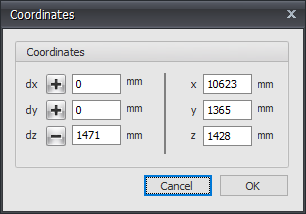
In this way, you can quickly insert your slab/plate.
Support and Loading
The plate can be supported in different ways: by Nodes and/or Plate edge.
You can enter Surface loads and/or Node loads.
Local Coordinate System
The x-axis of the local coordinate system of the plane load runs from the first point to the second point. With the display option Axis system plate you can make the local axes system of the plate visible. See Display options.

This function allows you to invert the direction of the contour line ("polyline"). By doing so you also influence the coordinate system of the plate.